Intro
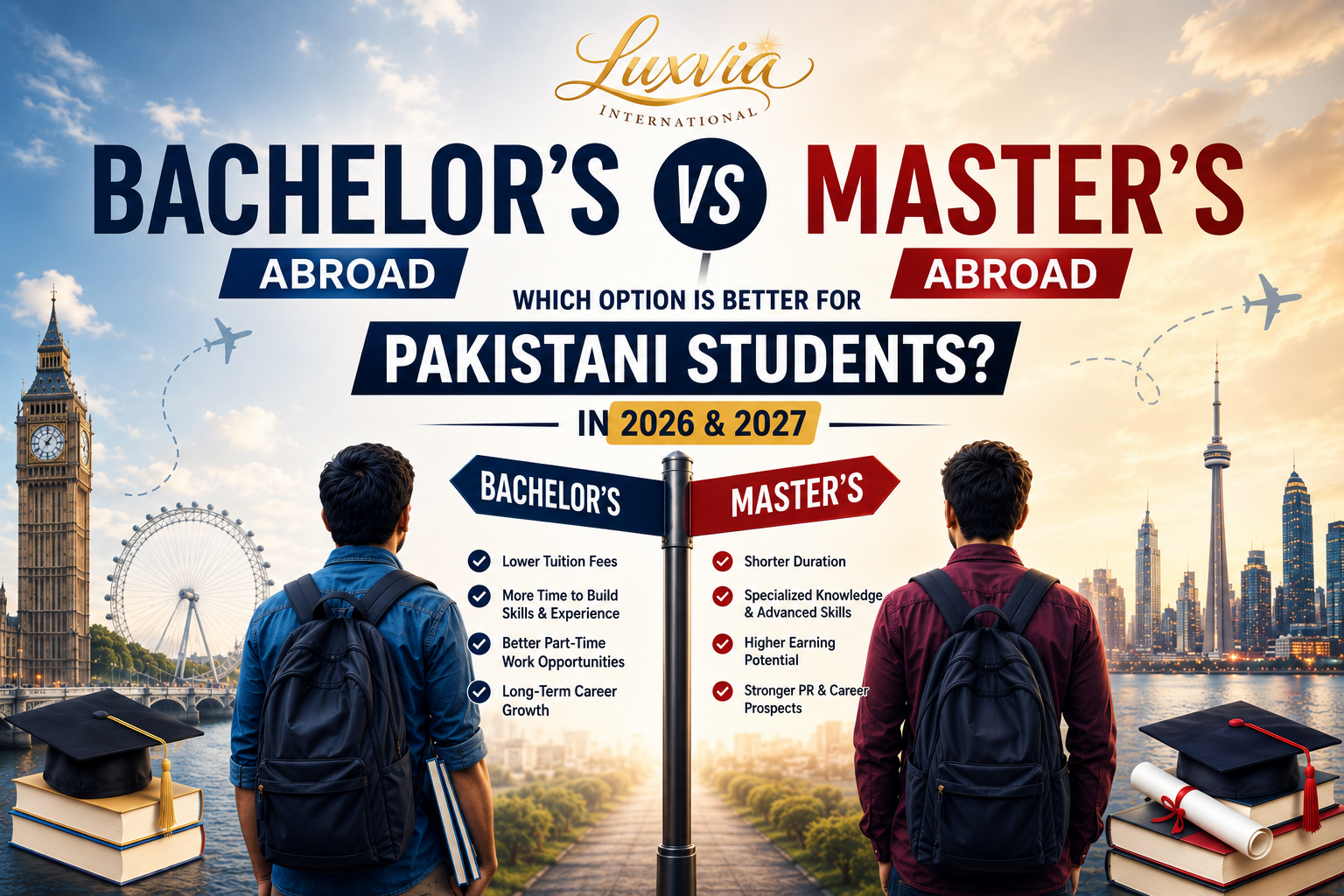
For Pakistani students planning to study abroad, one of the biggest decisions is whether to leave Pakistan after Intermediate and pursue a Bachelor’s degree abroad or complete a Bachelor’s degree in Pakistan and then apply for a Master’s abroad.
There is no universal answer. The better option depends on your academic qualifications, financial situation, career objectives, preferred destination and the type of degree you want to pursue.
A student who has just completed Intermediate may benefit from starting an international undergraduate degree, while another student may find it more practical to complete a local Bachelor’s degree and pursue a specialised Master’s programme overseas.
This guide compares both routes so Pakistani students can make a more informed decision for the 2026–27 admission cycle.
Bachelor’s Abroad vs Master’s Abroad: What Is the Difference?
The main difference is the stage at which you enter the international education system.
With the Bachelor’s abroad route, you complete your undergraduate education in another country after Intermediate, A Levels or an equivalent qualification.
With the Master’s abroad route, you first complete your undergraduate qualification in Pakistan and then apply for a postgraduate programme in another country.
The choice affects the total cost, duration of international study, admission requirements and the type of academic specialisation available.
Studying a Bachelor’s Abroad After Intermediate
Pakistani students who have completed Intermediate can apply for undergraduate programmes in many international destinations, subject to the university and programme requirements.
Depending on their academic background, students may apply directly to a Bachelor’s programme or may need a foundation, pathway or preparatory programme.
Popular undergraduate fields include:
- Computer Science
- Software Engineering
- Artificial Intelligence
- Business and Management
- Accounting and Finance
- Engineering
- International Business
- Data Science
- Cybersecurity
- Healthcare-related programmes
- Digital Marketing
Advantages of a Bachelor’s Abroad
One major advantage is the opportunity to experience an international academic environment from the beginning of university education.
Students can develop academic, communication and professional skills over several years while studying in their chosen destination.
A longer period abroad can also give students more time to understand the local education and employment environment, build professional networks and participate in internships or university activities where available.
Another advantage is that students can choose a specialised undergraduate programme that may not be available in the same format at Pakistani universities.
Disadvantages of a Bachelor’s Abroad
The biggest consideration is cost.
An international Bachelor’s degree generally requires several years of tuition and living expenses. Accommodation, food, transportation, insurance and other costs can add significantly to the total budget.
Students also need to consider the opportunity cost of spending their entire undergraduate period abroad instead of completing a degree in Pakistan at a potentially lower overall cost.
For families with limited budgets, this can make the Master’s route more financially practical.
Studying a Master’s Abroad After a Bachelor’s in Pakistan
The second route is to complete an undergraduate degree in Pakistan and then apply for a Master’s programme overseas.
This is particularly attractive for students who want to specialise in a specific field or gain an international postgraduate qualification.
For example, a student with a Bachelor’s degree in Computer Science may pursue a Master’s in:
- Artificial Intelligence
- Data Science
- Cybersecurity
- Cloud Computing
- Software Engineering
- Business Analytics
Similarly, a business graduate could specialise in Finance, International Business, Marketing, Management or Business Analytics.
Advantages of a Master’s Abroad
The primary advantage is the shorter period of international study compared with completing an entire Bachelor’s degree overseas.
In many destinations, Master’s programmes can be completed in approximately one or two years, depending on the course and university.
This can reduce the amount of time a student needs to pay international tuition and living expenses.
Another advantage is specialisation. Students can complete their undergraduate degree in Pakistan and then use a Master’s programme to move into a specific professional or academic area.
A postgraduate qualification can also strengthen an application when the chosen programme is logically connected to the student’s previous education and career objectives.
Disadvantages of a Master’s Abroad
Students applying for Master’s programmes must meet postgraduate admission requirements. These can include a relevant Bachelor’s qualification, minimum academic performance, English-language requirements and, for some programmes, professional experience or specific prerequisite subjects.
The available course choices may also be restricted by the student’s previous degree.
For example, a student with an unrelated academic background may not be eligible for a highly specialised Master’s programme.
Bachelor’s vs Master’s Abroad: Cost Comparison
Cost is one of the most important factors for Pakistani families.
A Bachelor’s abroad normally involves multiple years of:
Tuition + accommodation + food + transportation + insurance + visa-related expenses + other living costs.
A Master’s abroad generally involves a shorter period of international study, which can reduce the total expenditure.
However, the actual cost depends heavily on the country, university, programme and city.
A Master’s degree is therefore not automatically cheaper. Some postgraduate programmes have high tuition fees, and students must also account for living expenses.
The correct comparison is the total expected cost of the complete education route, rather than comparing one year’s tuition.
Which Route Requires More Financial Planning?
Both routes require careful financial preparation.
For a Bachelor’s abroad, families may need to demonstrate that they can support several years of education, subject to the financial requirements of the destination and visa route.
For a Master’s, the financial commitment may be concentrated into a shorter period.
Students should calculate:
- Tuition fees
- Accommodation
- Living expenses
- Health insurance
- Visa charges
- Travel expenses
- University deposits
- Books and other academic expenses
- Emergency funds
Do not select a destination solely because its tuition appears inexpensive. The total annual cost can be significantly different once accommodation and living expenses are included.
Bachelor’s vs Master’s: Admission Requirements
Typical Bachelor’s Requirements
Students applying after Intermediate may need:
- Matriculation certificate
- Intermediate certificate
- Academic transcripts
- Passport
- English-language test where required
- Personal statement or statement of purpose where required
- Recommendation letters for selected programmes
- Portfolio for certain creative programmes
- Additional documents required by the university
Some students may need a foundation or pathway programme depending on their qualification and the university’s entry requirements.
Typical Master’s Requirements
Students applying for postgraduate study commonly need:
- Bachelor’s degree
- Academic transcripts
- Passport
- English-language test where required
- CV
- Statement of purpose or personal statement
- Recommendation letters where required
- Professional experience for selected programmes
- Additional documents depending on the course
Requirements differ between universities, so students should always check the specific programme rather than assuming that every institution follows the same criteria.
Which Option Offers Better Career Opportunities?
The answer depends on the student’s career plan.
A Bachelor’s abroad can be beneficial for students who want to build their academic and professional foundation internationally from an early stage.
A Master’s abroad can be particularly useful for graduates who already have a Bachelor’s degree and want to develop specialised knowledge.
For example, a Pakistani graduate with a general business degree may use a Master’s abroad to specialise in Business Analytics, Finance, International Business or Marketing.
Likewise, a Computer Science graduate may pursue advanced study in Artificial Intelligence, Cybersecurity or Data Science.
The quality and relevance of the programme matter more than simply choosing Bachelor’s or Master’s.
Which Option Is Better for Scholarships?
Scholarship availability varies by country, university and programme.
Students should not assume that scholarships are available simply because they are applying internationally.
For Bachelor’s applicants, funding may be more limited or highly competitive depending on the destination.
Master’s students may have access to university scholarships, government-funded schemes, research-related funding or other postgraduate opportunities, depending on their academic profile and chosen programme.
Students with strong academic results, relevant extracurricular achievements, research experience or other competitive credentials should investigate scholarship opportunities before finalising their university shortlist.
Fully Funded Scholarships For Pakistani Students


https://luxviaint.com/fully-funded-scholarships-in-the-uk-germany-italy-china-romania-for-pakistani-students/
Bachelor’s or Master’s: Which Is Better for Pakistani Students?
Choose a Bachelor’s Abroad If:
A Bachelor’s abroad may be suitable if you:
- Have recently completed Intermediate or A Levels
- Have sufficient financial resources for several years overseas
- Want an international undergraduate experience
- Have a clear career direction
- Want to build international academic and professional networks early
- Have found a suitable undergraduate programme
Choose a Master’s Abroad If:
A Master’s abroad may be more suitable if you:
- Already hold a Bachelor’s degree
- Want to specialise in a particular field
- Want to reduce the number of years spent studying overseas
- Have limited resources for a longer international degree
- Want to change or advance your career within a related field
- Have relevant academic or professional experience
What About Students With a Study Gap?
A study gap does not automatically mean that studying abroad is impossible.
However, the acceptability of a gap depends on the university, country, programme and the circumstances behind the gap.
Students should be prepared to explain significant periods without formal education or employment and provide supporting documentation where appropriate.
Rather than hiding a gap, applicants should ensure that their academic and professional history is presented accurately and consistently.
What About Visa Considerations?
Choosing between Bachelor’s and Master’s should not be based on visa assumptions such as “Master’s visas are easier” or “Bachelor’s visas are guaranteed.”
Visa decisions depend on the requirements and assessment criteria of the relevant immigration authority.
Students may need to demonstrate factors such as:
- Genuine academic purpose
- Financial capacity
- Appropriate academic qualifications
- Required English-language proficiency
- Valid admission documentation
- Required health or character documents
- Compliance with the destination’s immigration rules
Requirements can change, so applicants should check the latest official rules before submitting a visa application.
Bachelor’s vs Master’s Abroad: Quick Comparison
| Factor | Bachelor’s Abroad | Master’s Abroad |
|---|---|---|
| Entry point | After Intermediate/A Levels | After Bachelor’s |
| International study duration | Usually longer | Usually shorter |
| Total potential cost | Generally higher | Generally lower overall |
| Specialisation | Starts earlier | Usually more specialised |
| Previous degree required | No | Yes |
| Career direction | Developed during degree | Usually more established |
| Scholarship options | Vary by destination | Vary; postgraduate funding may be available |
| Best suited for | School/college graduates | University graduates |
Final Verdict: Which One Should You Choose?
For Pakistani students, neither option is automatically better.
If you have recently completed Intermediate, have the financial capacity for several years abroad and want to build your undergraduate education internationally, a Bachelor’s abroad may be worth considering.
If you already have a Bachelor’s degree and want specialised education, international exposure and a shorter period of overseas study, a Master’s may be the more practical route.
The best decision should be based on academic background, budget, career objective, destination, course relevance and eligibility.
Before applying, compare universities and programmes carefully instead of selecting a country simply because it is popular among international students.
If you are unsure whether a Bachelor’s or Master’s route is more suitable for your profile, Luxvia International can help you assess your academic background, preferred destination and programme options before you begin the application process.
UK Desk Official Website:
https://www.gov.uk/contact-ukvi-inside-outside-uk
Leave a Reply