Introduction Of Post-Study Work Visa Rules
For most students, the degree was never really the finish line — the real question is: can I stay and work afterward? In 2026 that question got a lot more complicated. Several major study destinations tightened their post-study work rules, raised fees, or added new eligibility conditions, while a few countries actually strengthened their offer to attract international talent.
If you’re planning to study abroad in 2026, understanding these changes before you choose a country — not after you’ve already enrolled — can save you years of frustration. Here’s where things stand right now, country by country.
Quick Comparison: Post-Study Work Visas in 2026-2027
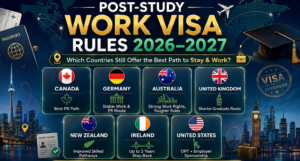
| Country | Visa Name | Typical Duration | Sponsorship Needed to Work? | PR Pathway |
|---|---|---|---|---|
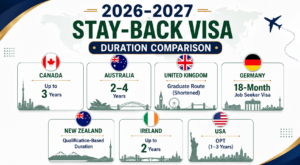
| Canada | PGWP | Up to 3 years (course-dependent) | No | Strong — feeds into Express Entry/PNP |
| Australia | Subclass 485 | 2–4 years (level-dependent) | No | Moderate — tightening in 2026 |
| UK | Graduate Route | Shortened in 2026 | No | Must switch to Skilled Worker visa |
| Germany | Job Seeker + Work Visa | 18 months to search, then work visa | No (search phase) | Strong — structured path to PR |
| New Zealand | Post-Study Work Visa | Varies by qualification | No | Strong — new skilled migrant pathways |
| Ireland | Third Level Graduate Scheme | Up to 2 years | No | Moderate |
| USA | OPT / STEM OPT | 1–3 years (STEM extension) | No | Weak without employer sponsorship |
Canada: Still the Most Reliable Route to Permanent Residency
Canada’s Post-Graduation Work Permit (PGWP) remains one of the most student-friendly systems in the world. Work experience gained under the PGWP feeds directly into Express Entry and Provincial Nominee Programs, giving graduates a genuine, well-documented path to PR — not just a temporary stay.
That said, Canada has tightened the front door: study permit caps are limiting how many students get in, and the government has lowered overall migration targets through 2027. The takeaway for prospective students is simple — get in with a PGWP-eligible program, because eligibility rules for certain courses have shifted more than once in the past year.
Best for: Students prioritizing a clear, structured path to permanent residency over a fast payday.
Study in Canada Complete Guide:
https://luxviaint.com/study-in-canada-2026/
Post-Graduation Work Permit (PGWP):
United Kingdom: A Shorter Runway, But Still Valuable
The UK’s Graduate Route has been shortened in 2026, and the government is generally pushing students toward longer settlement timelines with higher skill and salary thresholds before they can convert to a Skilled Worker visa. Bringing new dependents onto the Graduate Route is also no longer allowed (only dependents already present on a Student visa can remain).
The degree brand and job market access are still strong — but the UK now rewards speed. Students need to secure a qualifying, sponsoring job faster than before to make the transition stick.
Best for: Students in high-demand fields (STEM, healthcare) who can move quickly into skilled employment.
Study in UK Complete Guide:
https://luxviaint.com/study-in-the-uk-2026/
Graduate Visa:
https://www.gov.uk/graduate-visa
Australia: Strong Work Rights, Rising Barriers to Entry
Australia’s Temporary Graduate Visa (Subclass 485) still offers solid stay-back periods — generally 2 to 4 years for bachelor’s and master’s graduates, and up to 4 years for PhD holders, provided the course is CRICOS-registered. Students studying regionally often get added incentives.
The catch: Australia has raised fees and age limits and reduced some extension options in 2026, making eligibility barriers noticeably higher than a couple of years ago.
Best for: Postgraduate and PhD students, and anyone open to studying in a regional area for extra migration points.
Germany: The Quiet, Stable Option
While the UK and Australia have been busy tightening rules, Germany has stayed comparatively stable — and it’s increasingly on students’ radar for exactly that reason. Affordable tuition (often free or low-cost at public universities) is paired with a structured job-seeker visa (roughly 18 months to find work) that converts into a proper work visa and, eventually, a clear route to residency.
Best for: Budget-conscious students in engineering, IT, or technical fields who want stability over speed.
Study in Germany Complete Guide:
https://luxviaint.com/study-in-germany-2026/
New Zealand & Ireland: Smaller Markets, Strong Post-Study Offers
Both countries have kept — or even improved — their post-study pathways while bigger destinations pulled back. New Zealand raised its part-time work hour allowance to 25 hours per week and introduced new skilled migrant pathways starting in 2026. Ireland’s Third Level Graduate Scheme continues to offer up to two years of stay-back work rights.
Best for: Students who want strong work rights and a less saturated visa system, even if the university brand recognition is smaller than the UK or Australia.
United States: Prestige, But a Complicated Path
The US still offers Optional Practical Training (OPT), extendable for STEM graduates, giving up to three years of work authorization. However, converting that into long-term status still depends heavily on employer sponsorship through the H-1B lottery, which remains competitive and uncertain. Some clarity has been signaled around student visa holders applying for temporary work permits and green cards, but concrete guidance is still limited.
Best for: Students targeting elite employers who are willing to sponsor visas, and who are comfortable with more uncertainty long-term.
How to Choose: Match the Visa to Your Goal
Want the clearest path to PR? Canada or Germany.
Want the strongest short-term work rights with less red tape? New Zealand or Ireland.
Want the biggest brand-name degree and can move fast into a skilled job? UK.
Studying postgrad/PhD and want longer stay-back? Australia.
Chasing prestige and willing to gamble on sponsorship? USA.
FAQs
Do I need a job offer to get a post-study work visa? No — in Canada, Australia, the UK, Germany, and NZ, the initial post-study visa doesn’t require sponsorship. You need one later to convert it into a long-term work or skilled migration visa.
Can I switch jobs freely on a post-study work visa? Yes, in most countries (Canada, Australia, UK, Germany) you can change employers freely during the post-study work period.
Which country offers the easiest work-to-PR pathway right now? Canada is generally considered the strongest for a structured student-to-PR journey, with Germany close behind for stability.
Can I bring my spouse or family on a post-study work visa? Rules vary — Canada remains the most flexible, often allowing spouses to work. The UK and Australia have restricted adding new dependents during the post-study period.
Leave a Reply